
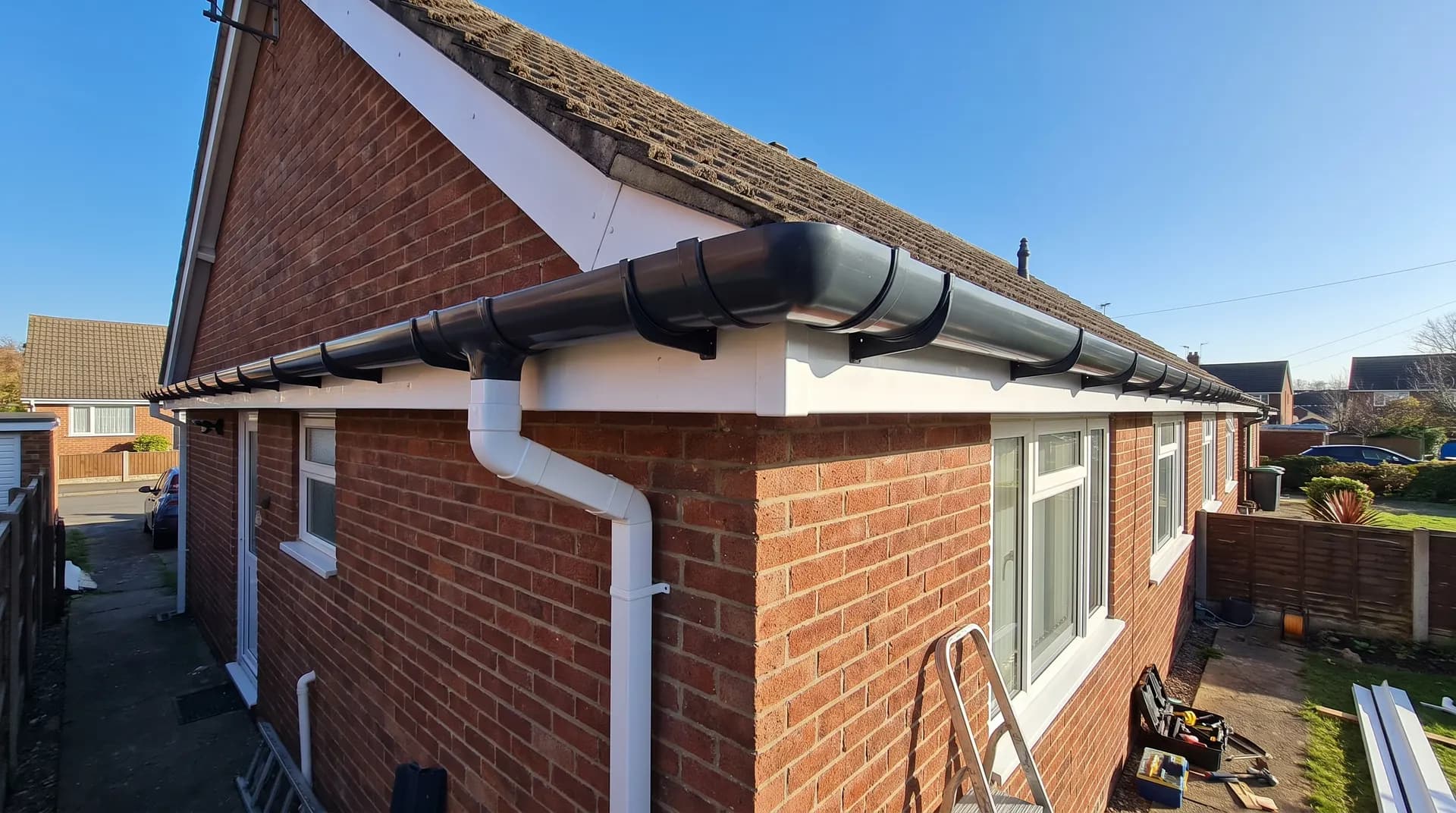
How to Fit Guttering
A practical guide to fitting uPVC guttering — work out the fall, fix the brackets at the right spacing, cut and joint the gutter lengths, fit the downpipe and test for leaks.
- Category
- Roofing
- Difficulty
- Beginner friendly
- Time
- 1 day
- Read
- 4 min
Roofing · Star Hawk Builders Merchant
A practical guide to fitting uPVC guttering — work out the fall, fix the brackets at the right spacing, cut and joint the gutter lengths, fit the downpipe and test for leaks.
4 min read 1 day Beginner friendlyPublished 12 July 2026
Plan the run and the falls
Measure the total length of the roofline you're guttering. Plan the high point at the far end of the run and the low point at the end where the downpipe will go. The standard fall is 10mm per 6m of run (1:600) towards the downpipe. For very long runs over 12m, fit two downpipes — one at each end — so the fall stays within sensible limits.
Pick the size of gutter (most domestic UK homes use 112mm half-round uPVC) and the downpipe size (typically 68mm round). Make a quick sketch with the positions of every bracket, union, stop-end, running outlet, and the downpipe run.
Tip: when ordering, allow one or two extra brackets for fixing near the downpipe and at any bends. Also buy lubricant spray for the rubber seals — it makes assembling the joints a 30-second job rather than a fight.
Fix the brackets
Brackets are screwed to the fascia board (the vertical board that runs along the roofline). Start by snapping a chalk line from the high point to the low point of the run, with the slope set at 10mm per 6m.
- Fix the first bracket at the high point end. Set it so the top of the bracket lines up with the chalk line, not the bottom — guttering sits in the bracket, so the bracket position determines where the water edge falls.
- Fix the last bracket at the low point end, lining up with the chalk line.
- Run a string line between the two brackets to confirm the fall is correct along the whole length.
- Fix intermediate brackets at every 600mm along the chalk line, with an extra bracket within 150mm of any joint or fitting.
Common mistake: fixing the brackets into the rafter feet instead of the fascia. The fascia is the structural board — rafter feet are often overshot by the tiles and the bracket pulls out within a season. Drive the screws into solid timber, not air.
Cut and fit the gutter lengths
Measure each run between brackets, then cut the gutter length to size using a fine-tooth saw or a specialist PVC gutter cutter. Cut square — a wonky cut shows at every joint. Deburr the cut with a knife or sandpaper so the rubber seal sits cleanly.
Lay a small bead of silicone sealant on each union before you push the lengths together, even though most modern brackets have rubber seals. As a general rule, double-seal every joint — they'll be the first place the gutter leaks in five years time.
Fit the gutter into the brackets, clip each length into place through the bracket, and check that the downpipe-running-outlet aligns with where the downpipe will fall on the wall below.
Fit the downpipe
The downpipe runs from the running outlet (the fitting that slots into the gutter) down the wall to the drain or soakaway. Mark its position on the wall, then fix downpipe brackets every 1.5m or so along the run.
Cut the downpipe lengths with a fine-tooth saw and assemble them with swaged ends upward so the upper length sockets into the lower one (water flows through the joint, not into it). At the bottom, fit a 45° shoe to direct the flow into the drain gully or hopper.
If the downpipe goes underground into the drain, make sure the connection rod-able — most UK installations use a standard 110mm PVCu drain pipe with a slip coupling. Put a leaf-guarding balloon in the drain while you work; the only thing worse than a blocked downpipe is a blocked drain at the same time.
Test the run
Wait for the next steady rain, or pour a bucket of water slowly into the gutter at the high end. Walk the run and watch every joint. Any drip is worth fixing now — once a gutter leaks it's hard to find the exact joint without taking the run apart.
Tip: drips at the corners usually mean the gutter is sitting too high at the low-point end or the bracket is out of plumb. Slacken the bracket screws, adjust the height, retighten, and the leak usually disappears.
Materials and tools checklist
Materials
- uPVC half-round gutter lengths (typically 4m)
- Gutter union brackets (one per joint)
- Gutter brackets (one per 600mm)
- Running outlet
- Stop-ends
- Downpipe lengths
- Downpipe brackets (every 1.5m)
- 45° downpipe shoe (or connection to drain)
- Silicone sealant
- Stainless-steel or coated screws
- Lubricant spray
Tools
- Tape measure, pencil, chalk line
- Spirit level
- Fine-tooth saw or PVC gutter cutter
- Drill and screwdriver bits
- Stanley knife (for deburring cuts)
- Ladder or scaffold tower
When to call a roofer
A single straight run of guttering on a single-storey extension is a fine DIY project; a multi-storey guttering replacement with several corners and awkward joins is more involved. Get a roofer in if:
- The fascia is rotten and needs replacing as well as the gutter
- The guttering is two or more storeys up (ladders and safety)
- The downpipe enters the underground drainage and needs a new connection
- The roofline is awkward (over conservatories, around bay windows, etc.)
We supply uPVC gutter, downpipe, brackets, sealants and fixings at trade prices, with next-day delivery across the South East.
Frequently asked questions
What is the correct fall for guttering?
1:600 is the standard — 10mm of fall for every 6m of gutter run. The fall should always run towards the downpipe, never away from it. For very long runs, fit two downpipes, one at each end, so each has the necessary fall.
PVC or metal guttering — which is better?
PVC is the standard for UK homes — cheap, light, easy to cut, and lasts 25+ years. Aluminium and cast iron last much longer but cost 3–5× more and need careful installation. For most domestic jobs, uPVC is the right default.
Can I replace a single damaged length of gutter without redoing the whole run?
Yes — lift the damaged length out of its brackets, cut a new length to the same measurement, fit it into two union brackets at each end. As long as the brackets themselves are sound, you don't need to replace the whole run.
What bracket spacing should I use?
Fix brackets at every 600mm for PVC guttering (1m for metal) plus one bracket within 150mm of each end, joint, or stop-end. Heavy snow loading (Scotland, North Pennines) wants brackets every 400mm to spread the weight.
How do I deal with a downpipe that goes into the ground?
Use a **rodding eye** at the base so the downpipe can be cleared if it blocks. If the pipe connects to a soakaway, lift the downpipe at the base every couple of years and flush with a hose. Most UK builders' merchants sell downpipe fittings that socket directly onto standard 110mm drain pipe.
Ready to start? Get a roofing materials list.
Send us your measurements or project plan and we'll come back with stock, a written quote and a delivery slot — usually within the hour during trade hours. from £8 per metre (materials only) for typical installs.
Related how-to guides
More step-by-step walkthroughs to help your project run smoothly.
How to Install an Outdoor Tap
Run a reliable cold-water supply from inside the house to an outside tap — isolation valve, drill through the wall, fit a self-cutting ferrule or through-wall fitting, and finish with a frost-protected tap.
How to Fit Guttering
A practical guide to fitting uPVC guttering — work out the fall, fix the brackets at the right spacing, cut and joint the gutter lengths, fit the downpipe and test for leaks.