
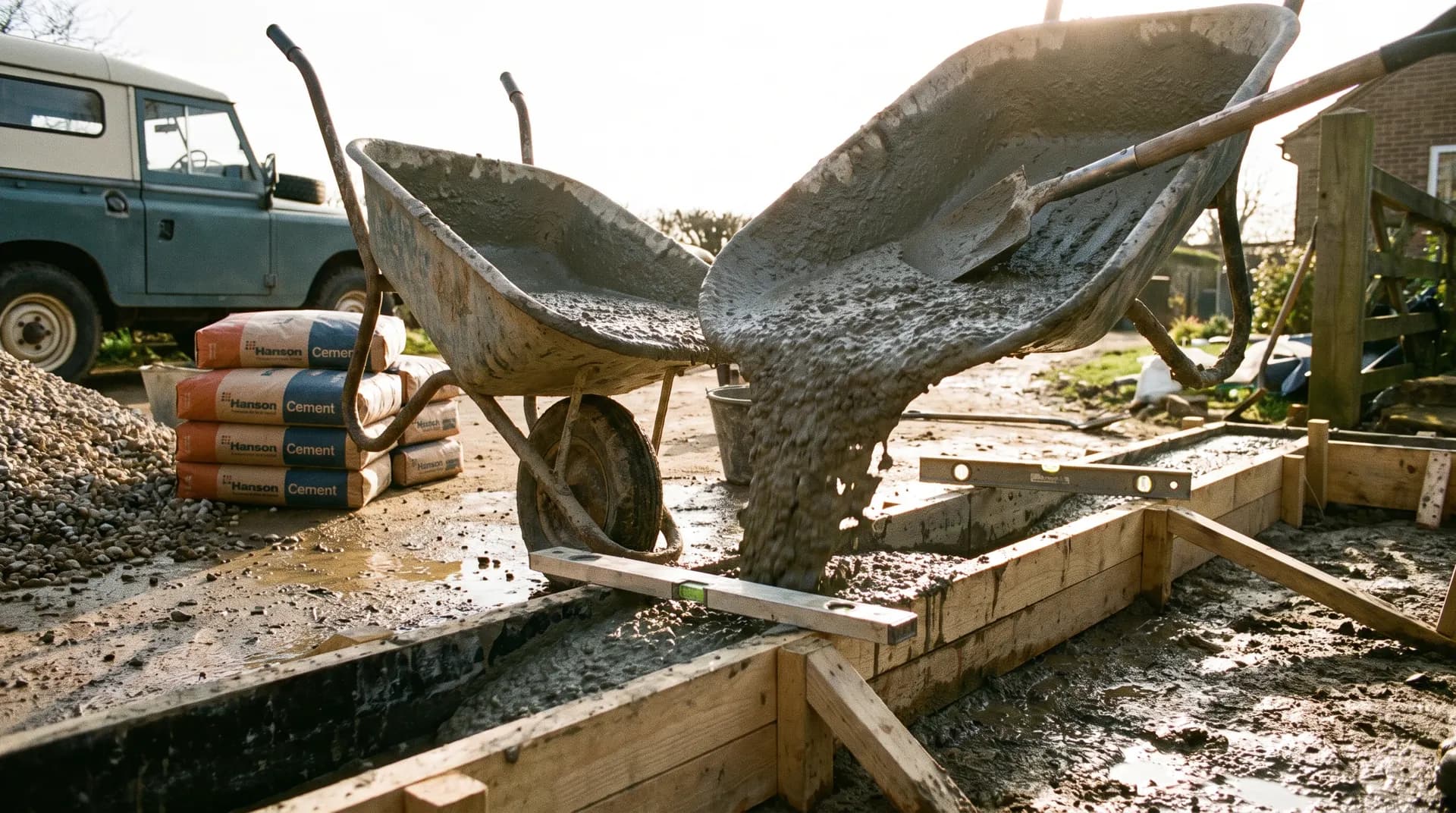
How to Mix Concrete
A practical guide to choosing the right concrete mix for the job, calculating how much you need, and mixing it properly by hand or in a small mixer — without weak, crumbly or cracking concrete.
- Category
- Concrete
- Difficulty
- Beginner friendly
- Time
- 30–45 minutes per batch
- Read
- 5 min
Concrete · Star Hawk Builders Merchant
A practical guide to choosing the right concrete mix for the job, calculating how much you need, and mixing it properly by hand or in a small mixer — without weak, crumbly or cracking concrete.
5 min read 30–45 minutes per batch Beginner friendlyPublished 6 July 2026
Pick the right mix for the job
Concrete isn't one thing — it's a family of mixes engineered for different loads and conditions. The mix you use depends on the job:
- C8 / C10 — non-structural fill, blinding, kerb backing. Lean mix.
- C20 / C25 — the everyday mix for shed bases, patios, fence posts, foundations for garden walls.
- C30 / C35 — structural slabs, garage floors, driveways that take car weight, ring beams.
- C40 and above — commercial floors, structural beams, agricultural yards.
If you're not sure, C20 is the right default for domestic DIY. Buy a quality-assured bagged concrete (post-mix, foundation concrete, or "C20" pre-blend) and you'll get a consistent mix every batch — no measuring, no wondering if your ratios are correct.
Tip: DIYers most often ruin concrete by using a sand-and-cement mortar mix (1:3) instead of a proper concrete mix (which has aggregate — gravel or ballast — for strength). A 1:3 sand-cement mix is mortar; it has no large aggregate and cracks under anything heavier than foot traffic.
Calculate how much you need
Volume = length × width × depth, in metres. Then add 10% for spillage, uneven ground and over-excavation. Always round up to the nearest 50kg bag or 0.25m³ if you're ordering ready-mix.
| Job | Typical size | Concrete needed |
| Fence post hole (75mm round × 600mm deep) | n posts | ~0.04m³ each |
| Standard garden shed base (3m × 3m × 100mm) | — | ~1.0m³ |
| Patio slab (under the slabs, not the bedding sand) | per m² at 100mm thick | 0.1m³ per m² |
| Driveway (4m × 6m × 150mm) | — | ~4.0m³ |
For larger pours (anything over about 1m³), it's almost always cheaper and faster to order ready-mix concrete by the metre than to mix it yourself.
Mix by hand — for small jobs
Hand-mixing works for batches up to about 100kg total. You need a smooth, flat surface — a mixing board, a concrete tray, or the back of a wheelbarrow with the handles braced.
- Measure your materials by bucket — one bucket of cement, two of sharp sand, four of 20mm ballast for a C20 mix.
- Combine dry — empty the aggregate onto the board first, then the sand, then the cement on top. Turn it over with a spade until the colour is uniform. This is the only way to get an even distribution of cement before you add any water.
- Form a crater in the middle of the pile. Add about half a bucket of clean water to start.
- Shovel from the outside in, mixing as you go, adding small amounts of water until the concrete is the consistency of thick porridge. It should hold its shape on the spade without slumping; if it slumps back, it's too wet.
- Use it within an hour. Concrete starts setting as soon as water hits the cement.
Mix with a small mixer — for medium jobs
Hire a 90-litre or 120-litre cement mixer for about £30 a day. They're worth the money for anything over 100kg of concrete. Two people can mix and place about 1m³ in a long afternoon if the access and the weather cooperate.
- Tip the aggregate in first, then the sand, then the cement.
- Run the mixer for a minute to dry-mix.
- Add water gradually through the hopper — start with about half a bucket, wait 30 seconds, add more until the mix comes together. Most operators add too much water; the mix should be just-wet, not sloshing.
- Tip the mixer into a wheelbarrow while it's still turning to keep the mix tumbling. Don't let it slump and stop — that means it's starting to set.
- Wash out the drum at the end of the job — hardened concrete is a nightmare to remove once cured.
Common mistake: leaving the mixer running between batches. It's tempting, but the mix sets against the drum and reduces capacity batch after batch. Stop it; tip it; restart.
Place, compact and cure
Concrete starts to set within 30–60 minutes of mixing, so get it into place quickly:
- Tip into the formwork / hole / trench. Don't drop it from more than about 1m — it will segregate (the aggregate falls out and the cement-rich slurry rises).
- Compact with a vibrating poker for deep pours, or by tamping and tapping the formwork with a hammer for shallow slabs. Compaction pushes air bubbles out and gets the aggregate down into the cement paste — without it the surface will be honeycombed and weak.
- Level and tamp the surface with a timber straight-edge (a "screed board") worked back and forth across the top of the formwork. Then float it smooth with a magnesium float, then steel-trowel for a hard finish if required.
- Cure for at least 3 days — and ideally 7. Cover with polythene, damp hessian, or spray with a curing compound. Concrete cures by hydration, so it needs moisture, not heat. Letting it dry out is the most common cause of dusty, cracked surfaces.
Materials and tools checklist
Materials
- Portland cement (or bagged C20 pre-mix)
- Sharp sand
- 20mm (or 10mm) coarse aggregate / all-in-ballast
- Clean water
- Plasticiser (optional — improves workability)
Tools
- Wheelbarrow or mixing board (hand-mixing)
- Cement mixer (hire for medium jobs)
- Spade / shovel
- Bucket (for measuring)
- Vibrating poker (for deep pours)
- Straight-edge for screeding
- Magnesium float and steel trowel
- Polythene sheeting for curing
When to order ready-mix or hire a specialist
For anything over 1m³, the case for ready-mix gets strong — cheaper materials, consistent mix, no mixer to wash out, and a one-shot pour means no cold joints. Call in a specialist if:
- The pour is structural (foundations, beams, garage floors)
- The volume is over 3m³ (you'll spend the entire day mixing by hand)
- Site access is awkward or you need a concrete pump
- You need a specified mix (e.g. C35 with fibre reinforcement for a driveway)
We stock cement, sand, ballast, post-mix and quality-assured bagged concrete at trade prices, with next-day delivery across the South East. Tell us your job and we'll work out the materials and the quantity.
Frequently asked questions
What is the best concrete mix ratio for a shed base?
Use a C20 mix (1 part cement, 2 parts sharp sand, 4 parts aggregate) or a quality-assured pre-mixed bagged concrete. Aim for 100mm thickness for a standard garden shed, more if it's a heavy item like a hot tub.
Can I mix concrete by hand?
Yes, for small jobs up to about 100kg total. A wheelbarrow or a mixing board works well; turn it three times dry before adding water gradually. For larger pours, hire a small mixer (about £30 per day) or order ready-mix delivered.
How long does concrete take to set?
Concrete starts to firm up within about 30 minutes of mixing and reaches 'initial set' in 1–2 hours. It reaches walking strength overnight, but it needs a full 28 days to reach its design strength. Keep it damp for the first week.
What happens if I add too much water to concrete?
The mix becomes easier to pour but loses strength. A typical rule is that every 10% of extra water knocks roughly 15% off the final compressive strength. Aim for the stiffest mix you can work into place — not a wet slurry.
How much concrete do I need for a 3m × 3m slab at 100mm thick?
Volume = 3 × 3 × 0.1 = 0.9m³. Order 10% extra for spillage and uneven ground, so about 1m³. One cubic metre of ready-mix concrete weighs about 2.3 tonnes, so make sure your site access can take that weight if you order a delivery.
Ready to start? Get a concrete materials list.
Send us your measurements or project plan and we'll come back with stock, a written quote and a delivery slot — usually within the hour during trade hours. from £90 per m³ (materials only) for typical installs.
Related how-to guides
More step-by-step walkthroughs to help your project run smoothly.
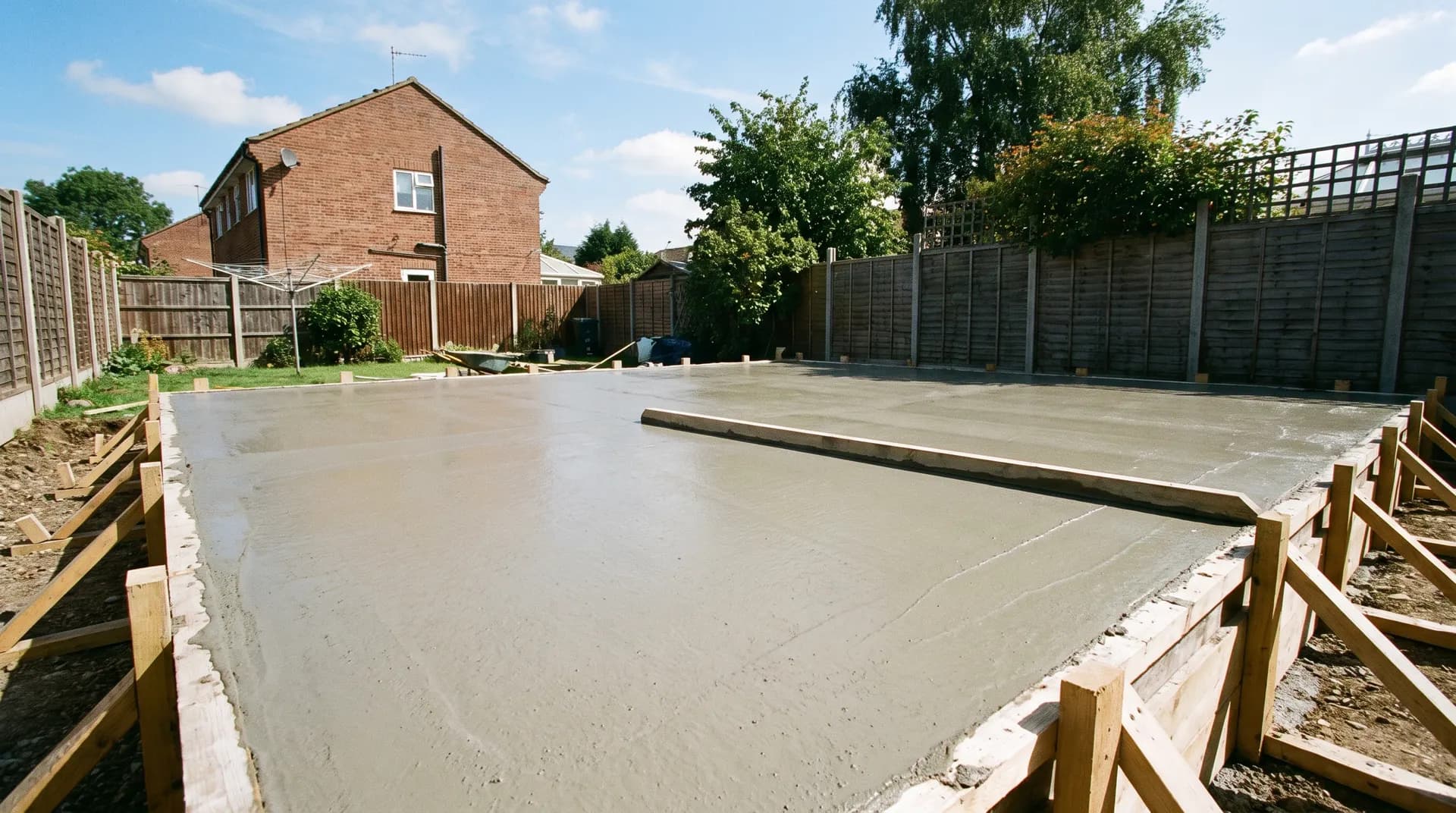
How to Lay a Concrete Base
Lay a flat, level, durable concrete base for a shed, greenhouse or hot tub — set out the dig, build the formwork, pour and finish the concrete, then leave it to cure properly.
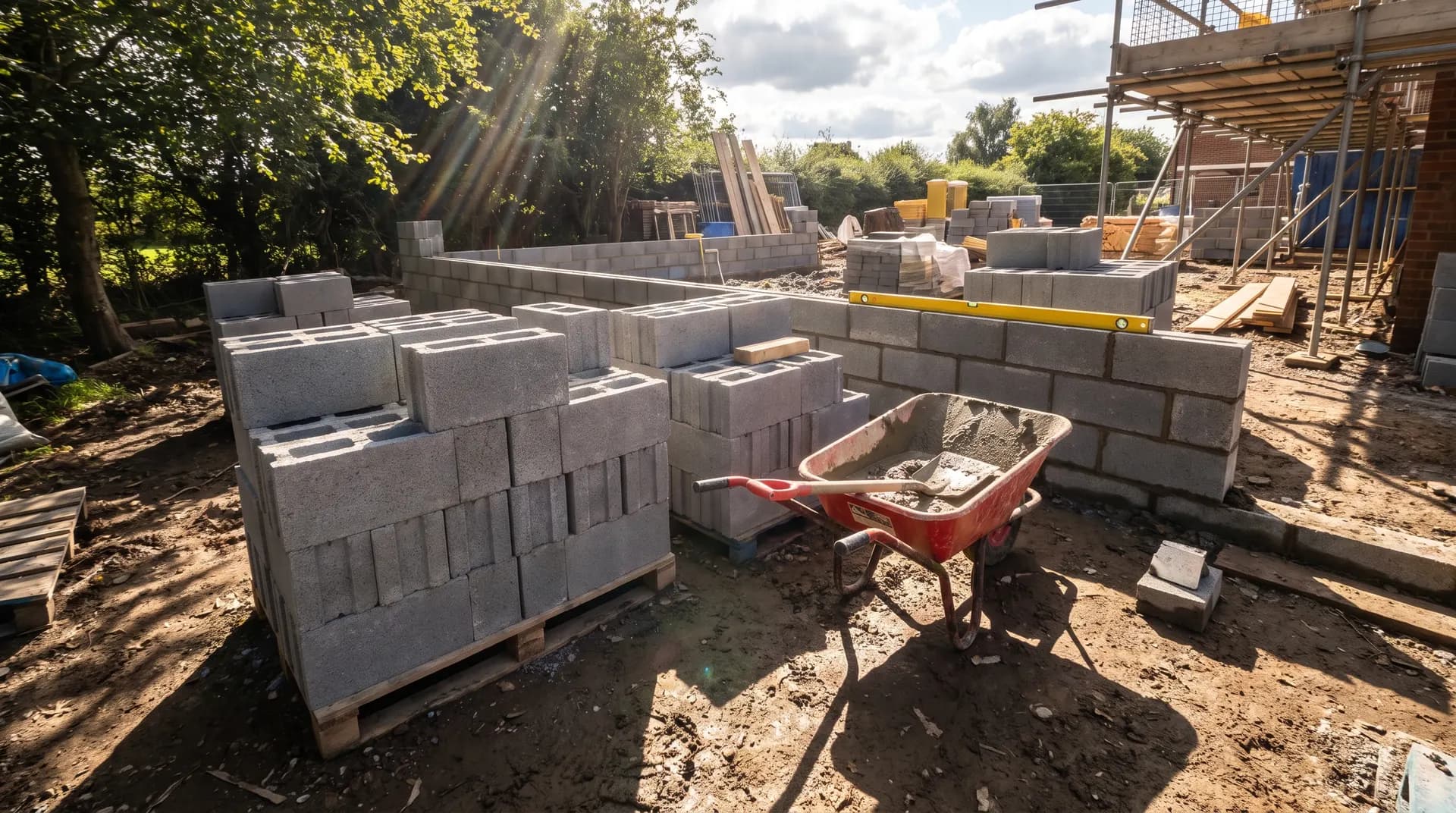
How to Build a Block Wall
How to build a clean, level block wall that will stand the test of time — from setting out, through the foundation, mortar mix and laying every course to a crisp brushed finish.