
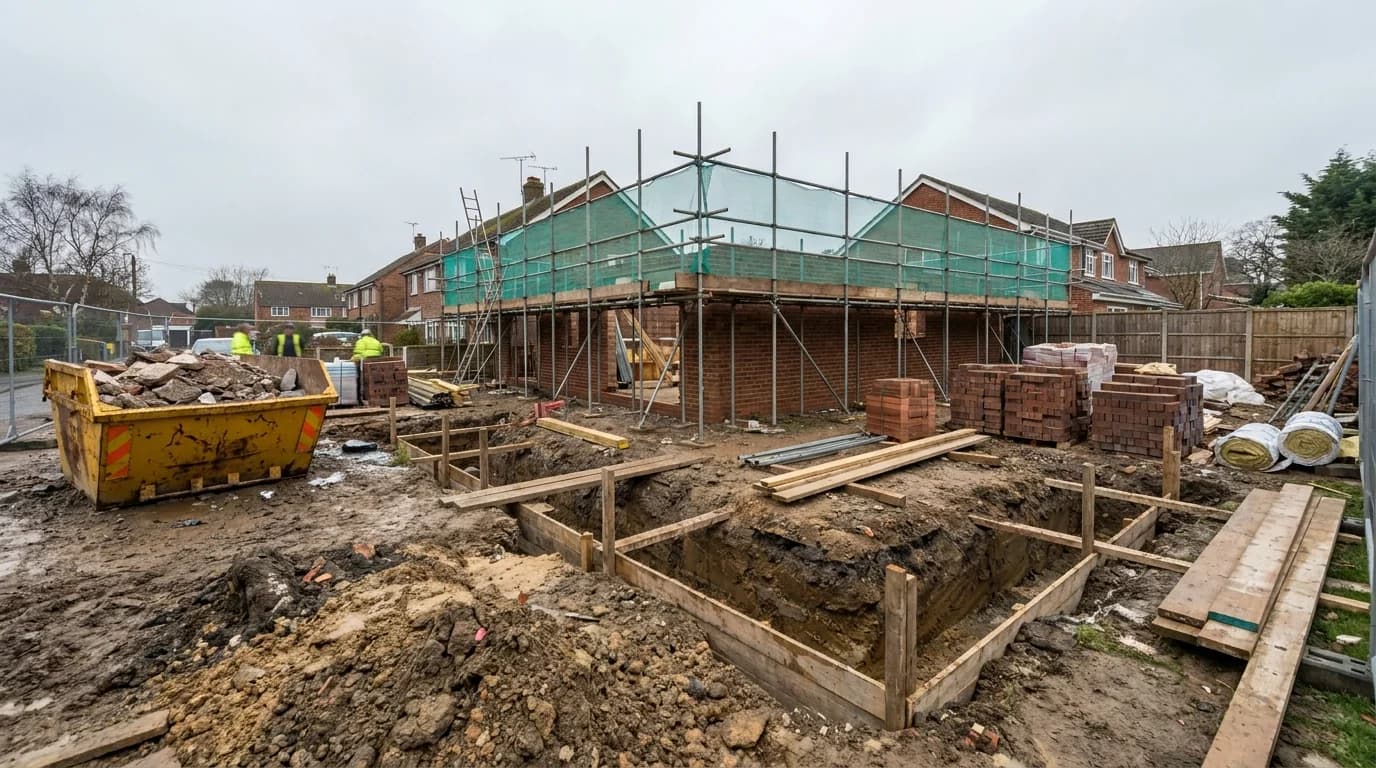
Hidden costs that blow your extension budget
The builder's quote is only part of the cost. Planning fees, building regulations, skips, scaffolding and contingencies can add thousands. Here is what to budget for.
- Category
- Budgeting
- Author
- Star Hawk Builders Merchant
- Date
- 17 October 2024
- Read time
- 5 min
Budgeting · Star Hawk Builders Merchant
The builder's quote is only part of the cost. Planning fees, building regulations, skips, scaffolding and contingencies can add thousands. Here is what to budget for.
5 min read · Published 17 October 2024
The builder's quote for your extension is not the total cost. It covers the physical construction, but there are many other expenses that sit outside the quote. Homeowners who forget these costs often find their budget blown before the project is halfway done.
Understanding the full picture helps you set a realistic budget and avoid nasty surprises.
Professional and statutory fees
These are the costs you pay before a single brick is laid.
Planning application
If your project needs planning permission, a householder application in England currently costs £462. You can check current fees and rules on the Planning Portal. Even if you do not need permission, a Lawful Development Certificate costs around half that and is worth having when you sell.
Building regulations approval
Almost every extension needs building regulations approval. Your local authority or an approved inspector will charge £500–£1,200 depending on project size.
Architectural drawings
If you need plans for planning or building control, expect to pay £1,000–£3,000 for design and drawings. Some builders offer design-and-build packages that include this.
Structural engineer
Any steel beam, removal of a load-bearing wall or significant structural alteration needs calculations by a structural engineer. Budget £400–£800.
Party wall surveyor
If your extension affects a shared wall or boundary, and your neighbour does not consent in writing, you may need a party wall surveyor. Costs are typically £700–£1,500 per neighbour.
On-site extras
These costs often appear during the build rather than in the original quote.
Skips
An extension generates a lot of waste. Most projects need 3–6 skips at £250–£400 each. If access is difficult, prices rise.
Scaffolding
Scaffolding for a single-storey extension might cost £500–£1,000. For a two-storey project or complex access, it can be £1,500 or more.
Temporary electrics and water
If your existing supplies need rerouting during the build, budget £200–£500.
Tree and asbestos surveys
Mature trees near foundations may need a tree survey (£300–£600). Pre-2000 properties often need an asbestos survey (£200–£400).
Service diversions and utility fees
Extensions sometimes affect drains, gas pipes, water mains or electricity cables. Moving a manhole or diverting a sewer can cost £1,000–£5,000 depending on depth, length and who owns the pipe.
Contact your utility companies early. Some diversions need weeks of notice, and emergency work is always more expensive than planned work.
Insurance and temporary works
Your builder should have public liability and contractor's insurance, but you should also tell your home insurer about the project. Some policies need a temporary extension or a separate site insurance policy.
Temporary works such as propping, shoring, access ramps and fencing may not be in the builder's quote. For complex projects, allow £500–£2,000.
Specification upgrades
Once work starts, it is easy to decide to upgrade. These choices add up quickly:
- Aluminium bifold doors instead of uPVC.
- Underfloor heating instead of radiators.
- Higher-grade kitchen units or worktops.
- Better insulation for improved energy efficiency.
- Premium tiles or flooring.
Decide your must-haves before quoting and stick to them.
Ground condition surprises
Until you start digging, you cannot be certain what is under the ground.
- Poor soil may require deeper or reinforced foundations.
- High water table can complicate drainage.
- Unmapped drains may need rerouting.
- Buried rubble or contamination can add clearance costs.
This is why a contingency fund is essential.
Existing defects
Opening up an existing house often reveals problems:
- Rotten timber joists or lintels.
- Damp or defective walls.
- Outdated electrics or plumbing.
- Insufficient existing foundations.
These are not the builder's fault, but they still need fixing.
Finishing costs
The builder's quote may end at plastering, leaving you to budget for:
- Painting and decorating.
- Floor finishes.
- Kitchen units, worktops and appliances.
- Bathroom fittings.
- Light fittings and sockets.
- Curtains, blinds and furniture.
These finishing touches can easily add £5,000–£20,000 depending on taste.
Cleaning, gardening and making good
Once the builders leave, the work is not quite finished. You may need:
- A professional clean to remove construction dust.
- Garden repair after excavators and deliveries.
- New paths, patios or fences removed during the build.
- Redecorating rooms disturbed by the work.
Budget £500–£2,000 for these final touches. If you are replanting a lawn or installing new fencing, the total can rise further.
VAT on professional fees
VAT can add 20% to many professional services on top of the builder's quote. Architects, structural engineers, surveyors and some building control inspectors charge VAT. If your budget is tight, confirm whether each professional's fee includes VAT before you commit.
Living costs during the build
If the project affects your kitchen or only bathroom, you may need to eat out, use a launderette or stay elsewhere for part of the build. These day-to-day costs add up:
- Takeaway meals or dining out: £20–£50 per day for a family.
- Portable toilet hire if the main bathroom is out of action: £100–£200 per month.
- Temporary accommodation for major renovations: £500–£1,500 per week.
Factor these into your budget, especially for kitchen extensions or whole-house renovations.
Small items that add up
It is easy to overlook the small purchases that accompany a build:
- Extra sockets, switches and light fittings.
- Sealants, adhesives, screws and fixings.
- Door furniture, handles and hinges.
- Curtain poles, blinds and outdoor lights.
- New bins, outside taps or vent covers.
Individually these may cost £10–£100, but together they can easily add £500–£1,500 to the final bill. The same applies to finishing trades such as carpet fitting, curtain installation and tiling, which are often left out of the main builder's quote.
The contingency rule
Set aside a contingency on top of the total project cost:
- 10–15% for straightforward extensions on modern properties.
- 15–20% for older properties, complex sites or projects with structural alterations.
This is not pessimistic. It is realistic. If you do not use it, you have a bonus. If you need it, you are glad it exists.
How to budget accurately
- Start with the builder's quote.
- Add professional fees, statutory fees and surveys.
- Add on-site extras like skips and scaffolding.
- Add service diversions, insurance and temporary works if needed.
- Add your chosen finishing costs.
- Add a contingency.
- Keep a £1,000–£2,000 buffer for unexpected small items.
Example budget for a £50,000 extension
| Cost | Amount |
| Builder's quote inc VAT | £50,000 |
| Planning / lawful development | £500 |
| Building control | £800 |
| Structural engineer | £600 |
| Skips | £1,200 |
| Scaffolding | £900 |
| Finishes (kitchen, flooring, decoration) | £12,000 |
| Contingency 15% | £9,900 |
| Total realistic budget | £75,900 |
That is a big difference from the headline £50,000. Being honest about the full cost from the start prevents the stress, worry and delay of running out of money halfway through.
To lock in your material costs, request a written quote from Star Hawk Builders Merchant. We deliver across the South East and you can find your nearest branch.
Frequently asked questions
What percentage should I add as a contingency?
Add 10–15% for a straightforward project and 15–20% for older properties or projects involving structural alterations.
Are architect fees included in a builder's quote?
Usually not. Architectural drawings, structural engineer calculations and planning fees are separate professional costs.
How much do building regulations cost?
Building control fees typically range from £500 to £1,200 for an extension, depending on size and local authority.
Do I need to budget for skips?
Yes. A typical extension needs 3–6 skips at £250–£400 each, depending on size and location.
Need materials for your project?
Send us your material schedule and we'll come back with stock availability, a written quote and a delivery slot, usually within the hour during trade hours.
Related articles
More guides and advice to help your building project run smoothly.
How to compare builder quotes line by line
Comparing builder quotes is not about finding the lowest number. It is about making sure every builder is pricing the same scope, specification and terms.

When and how to pay your builder
Paying your builder the right way protects your money and keeps the project moving. Here is how to structure deposits, staged payments and final balances.