
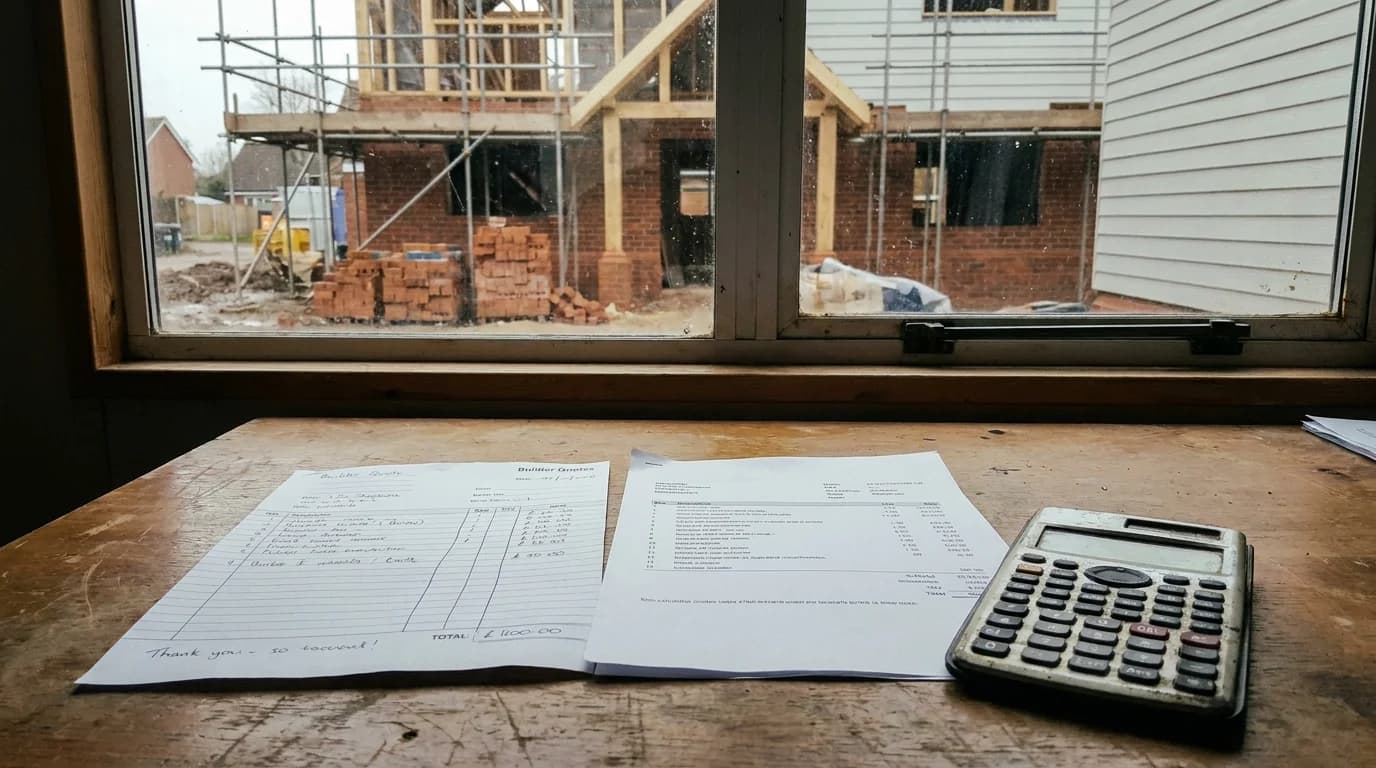
How to compare builder quotes line by line
Comparing builder quotes is not about finding the lowest number. It is about making sure every builder is pricing the same scope, specification and terms.
- Category
- Quotes & contracts
- Author
- Star Hawk Builders Merchant
- Date
- 16 May 2024
- Read time
- 6 min
Quotes & contracts · Star Hawk Builders Merchant
Comparing builder quotes is not about finding the lowest number. It is about making sure every builder is pricing the same scope, specification and terms.
6 min read · Published 16 May 2024
Three quotes for the same extension can range from £38,000 to £62,000. That gap is not because builders are guessing randomly. It is usually because they are quoting for different things. The Federation of Master Builders recommends getting at least three written quotes before you choose a builder.
If you compare only the bottom-line numbers, you are not comparing quotes — you are comparing assumptions. To choose the right builder, you need to normalise the quotes so every figure covers the same scope, specification and terms. Once you have chosen a builder, request a materials quote from Star Hawk Builders Merchant and find your nearest branch.
Step 1: Make sure the scope is identical
Before you compare prices, check that each builder is quoting for the same work. Common differences include:
- One builder includes foundations and drainage; another assumes they are already done.
- One includes plastering and decoration; another stops at plasterboard.
- One includes making good the garden; another leaves the site as a muddy mess.
- One includes a structural engineer; another expects you to arrange that separately.
Create a simple checklist of what you expect the project to include and tick it off against each quote. If an item is missing, ask the builder to add it.
Step 2: Compare material specifications
Two quotes can both say "supply and fix kitchen extension" while using very different materials. Ask each builder for a basic specification covering:
- Block and brick type and strength.
- Insulation type and thickness.
- Timber grade for studwork, joists and rafters.
- Window and door frames (uPVC, aluminium, timber).
- Roofing material (tiles, slate, membrane).
- Kitchen, bathroom or finishing allowances if applicable.
A lower quote may use thinner insulation, lower-grade timber or cheaper windows. That is not necessarily wrong, but you need to know what you are comparing.
Step 3: Look at labour separately
If a builder separates labour and materials, you can see the daily rate and the number of days allowed. This helps you spot:
- Unrealistically short schedules that suggest rushed work.
- Excessively high day rates compared to your area.
- Missing trades such as plumbing, electrics or plastering.
Even if the quote is a single figure, ask how many weeks the builder expects the work to take.
Step 4: Check for VAT consistency
Some builders quote excluding VAT, especially if they are near the VAT threshold or if the homeowner asks for a "cash price." Make sure you compare all quotes on the same basis. For domestic work, the figure that matters is the total amount you will actually pay.
Step 5: Identify provisional sums and allowances
A provisional sum is an estimated cost for something that cannot be priced exactly yet. For example:
- Groundworks, if ground conditions are unknown.
- Drainage connections, if the existing layout is unclear.
- Kitchen units, if you have not chosen them yet.
Compare the provisional sums in each quote. A builder with low provisional sums may look cheaper, but you could end up paying much more later.
Step 6: Compare payment terms
Payment schedules affect your cash flow and your risk. Compare:
- Deposit amount.
- Whether payments are linked to milestones.
- Final retention amount.
- When the final payment is due.
A builder who wants 50% upfront is very different from one who takes staged payments as work is completed.
Step 7: Read the exclusions
The exclusions section is often where the real differences hide. Look for phrases like:
- "Decoration not included."
- "Kitchen units by others."
- "No groundworks."
- "Client to arrange scaffolding."
- "Building regulations fees not included."
If one quote excludes several items that another includes, add the estimated cost back in to compare fairly.
Step 8: Compare the builder, not just the price
A quote is only as good as the builder behind it. Before deciding, consider:
- References and past work.
- Insurance and qualifications.
- Communication during the quoting process.
- How realistic the programme feels.
- Whether they answer your questions patiently.
The builder who explains their quote clearly is usually the builder who will manage the project clearly.
Red flags hidden in a quote
Some warning signs only appear when you read the detail:
- No expiry date. Prices can change, and an open-ended quote creates uncertainty.
- Vague descriptions. "Supply and fit bathroom" does not tell you which suite or tiles are included.
- Large round numbers. A quote with every line item ending in £000 suggests it was guessed, not calculated.
- Missing waste removal. Skips and disposal are real costs that someone has to pay.
- No mention of building regulations. Approval fees and inspections should be accounted for.
If you spot these, ask the builder to clarify. A reluctance to provide detail is a red flag in itself.
A simple comparison spreadsheet
Create a table with the following rows:
| Item | Builder A | Builder B | Builder C |
| Total inc VAT | £ | £ | £ |
| Foundations/groundworks | Y/N | Y/N | Y/N |
| Structure/walls/roof | Y/N | Y/N | Y/N |
| Windows/doors | Y/N | Y/N | Y/N |
| Electrics/plumbing | Y/N | Y/N | Y/N |
| Plastering | Y/N | Y/N | Y/N |
| Decoration/finishes | Y/N | Y/N | Y/N |
| Waste removal | Y/N | Y/N | Y/N |
| Making good outside | Y/N | Y/N | Y/N |
| Provisional sums | £ | £ | £ |
| Payment schedule |
This quickly shows which quote is genuinely competitive and which one has hidden gaps.
How to negotiate after comparing
Once you have a clear comparison, you can negotiate without simply asking for a discount. Try:
- "Builder B has included X for £Y. Can you match that line item?"
- "Can we fix the provisional sum for groundworks rather than leave it open?"
- "If I agree to a winter start, can you improve the labour rate?"
The goal is fair value, not the cheapest possible price. TrustMark advises homeowners to get any agreed changes written into the quote before accepting it.
When to walk away from a quote
Sometimes a quote is so vague, pushy or cheap that the best response is to discard it. Walk away if:
- The builder refuses to itemise the price.
- They demand a large cash deposit to "hold the price."
- They cannot explain why their price is far below the others.
- The quote has no expiry date, no exclusions and no payment terms.
- They pressure you to sign before you have seen other quotes.
A missing quote is better than a bad contract. The time you spend getting a proper comparison is always less than the time spent fixing a bad hire.
What to do if the quotes are very different
If one quote is much higher or lower than the others, ask the builder to explain. A good builder will walk you through it. Vague answers or reluctance to itemise are red flags.
The goal is not to beat the price down to the lowest number. It is to find the builder who offers the best combination of fair price, clear scope and trustworthy delivery.
Frequently asked questions
How many builder quotes should I get?
Get at least three quotes for the same scope of work. You may need to contact five or six builders to receive three responses.
What should a builder's quote include?
A proper quote includes a description of the work, labour and materials, waste removal, VAT, payment schedule, exclusions and an expiry date.
Why do builder quotes vary so much?
Quotes vary because of different specifications, labour rates, overheads, profit margins, provisional sums and what each builder includes or excludes.
Should I ask for a fixed-price quote?
Yes, where possible. A fixed-price quote gives you cost certainty unless the scope changes.
Need materials for your project?
Send us your material schedule and we'll come back with stock availability, a written quote and a delivery slot, usually within the hour during trade hours.
Related articles
More guides and advice to help your building project run smoothly.
Why the cheapest builder quote often costs you more
A cheap quote is tempting, but it often hides missing items, lower specifications and future extras. Here is why the lowest price rarely means the best value.
Hidden costs that blow your extension budget
The builder's quote is only part of the cost. Planning fees, building regulations, skips, scaffolding and contingencies can add thousands. Here is what to budget for.