
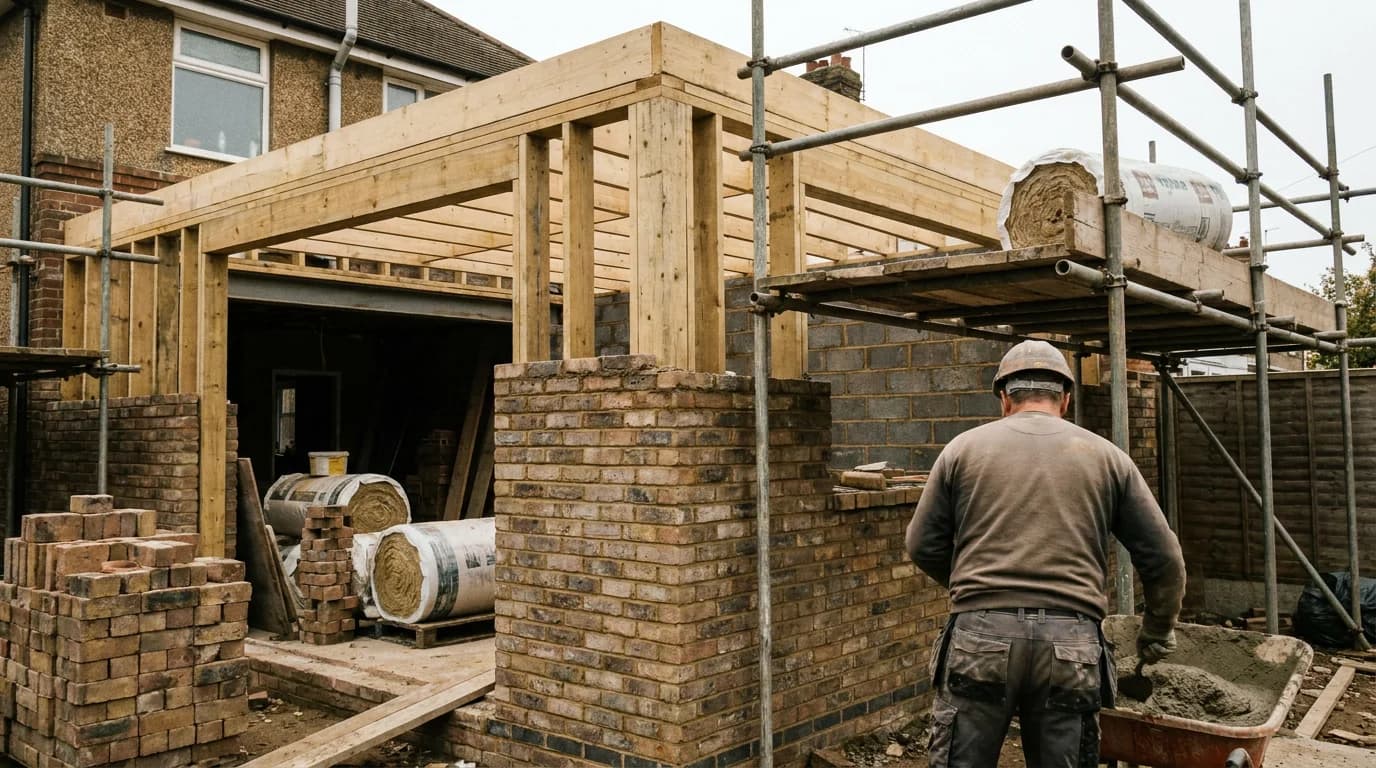
First-time homeowner's guide to building works
Planning your first building project can feel overwhelming. This guide breaks down budgeting, scheduling, choosing materials and working with builders so you can move forward with confidence.
- Category
- First-time buyers
- Author
- Star Hawk Builders Merchant
- Date
- 16 April 2026
- Read time
- 5 min
First-time buyers · Star Hawk Builders Merchant
Planning your first building project can feel overwhelming. This guide breaks down budgeting, scheduling, choosing materials and working with builders so you can move forward with confidence.
5 min read · Published 16 April 2026
Buying your first home is exciting, but the moment you start thinking about an extension, a new kitchen or even just replacing a garden wall, the questions pile up. How much will it cost? Do you need planning permission? How do you find a builder you can trust? And how do you make sure the materials arriving on site are the right ones?
This guide is written for first-time homeowners in Berkshire, Buckinghamshire, Surrey, Hampshire, Oxfordshire and West London who want to run a small-to-medium building project without losing sleep or money.
Understand your home before you design
Before you sketch an extension, spend time understanding the building you already own.
- How old is the house and what has been altered before?
- Are the foundations shallow, deep or unknown?
- Is there asbestos in old Artex, pipe lagging or garage roofs?
- Are electrics and plumbing up to date?
- Are there signs of damp, subsidence or rotten timber?
A pre-project survey or a builder's walkaround can reveal issues that should be budgeted for before you commit to a design. Discovering them halfway through is far more expensive.
Start with a realistic budget
Before you pick up a tape measure, decide what you can actually afford. A common mistake is to budget for the visible finishes — the kitchen, the bi-fold doors, the tiles — and forget the structural skeleton that holds it all up.
For a single-storey rear extension, budget around £1,800–£2,500 per square metre including VAT. That covers foundations, walls, roof, glazing, electrics, plastering and basic finishes. Add 10–15% on top as a contingency. Old houses throw up surprises: drains in the wrong place, asbestos, rotten timbers, unstable subsoil.
Choose the right design route
Most first-time homeowners choose between two paths:
- Architect-led design: You hire an architect or architectural technologist to draw plans, then tender to builders. This gives you more control and often a better design, but it takes longer and costs more upfront.
- Design-and-build: The builder provides plans and construction together. This is faster and simpler, but make sure you still review the design carefully and compare the price against independent quotes.
For a small, straightforward extension, a design-and-build package can work well. For a complex or high-spec project, an architect is usually worth the investment.
Understand planning and building regulations
Not every project needs full planning permission. Many rear and side extensions fall under permitted development, but the limits are strict. You can check the rules on the Planning Portal.
- Single-storey rear extensions must not extend beyond the original rear wall by more than four metres for a detached house, or three metres for other houses.
- Maximum height is usually four metres.
- Side extensions are generally not permitted on designated land.
Even if planning is not required, building regulations approval almost always is. This covers structural safety, insulation, damp proofing, ventilation and electrical work. Your builder or architect can submit the application, but make sure you receive the completion certificate at the end.
Choose the right builder
A good builder is worth more than the cheapest quote. Ask for:
- At least two recent references and the addresses of completed jobs.
- Proof of public liability insurance and employer's liability insurance.
- A written quote, not a scribbled estimate.
- A clear start date, payment schedule and warranty.
Never pay the full amount upfront. A typical schedule is 25% on start, staged payments through the project, and the final 5–10% only after snagging is complete.
How to read a builder's quote
A proper quote should be itemised. Look for:
- Labour and materials separated where possible.
- A list of major materials and their specifications.
- Waste removal, scaffolding and skips.
- VAT included or clearly stated as excluded.
- Payment stages and what triggers each one.
- A list of exclusions, such as decoration or kitchen units.
If a quote is a single number with no detail, ask for a breakdown. If the builder refuses, find another builder.
Order materials in the right sequence
One of the biggest causes of delay is a missing material. A builder cannot lay a block wall if the blocks have not arrived, and concrete cannot wait while you chase up a last-minute cement delivery.
Plan your material orders around the build sequence:
- Groundworks: aggregates, MOT Type 1, sand, cement, concrete, damp-proof membrane.
- Structure: blocks, bricks, lintels, steel beams, timber, insulation.
- Roof and openings: rafters, tiles, membrane, windows, doors.
- First fix: cables, pipes, plasterboard.
- Second fix: skirting, architrave, paint, flooring, fixtures.
If you are managing the build yourself, order structural items two weeks ahead. If your builder is supplying, agree who is responsible for each delivery and confirm the date in writing.
Protect yourself from common traps
- The verbal variation: any change to the scope must be written down and signed off, including cost and time impact.
- The cash-only builder: this usually means no VAT invoice, no warranty and no comeback.
- The disappearing deposit: never hand over more than 25% before work starts.
- The wrong materials: always compare what arrives on site with the specification. A 100mm block is not the same as a 140mm block, and the difference matters for U-values and structural calculations.
Get a quote for materials early
Even if your builder is supplying, it is worth getting a separate materials quote so you can compare. Star Hawk supplies aggregates, bricks, blocks, timber, insulation, roofing, plasterboard and fixings with same-day or next-day delivery across the South East. A written quote locks in prices and helps you spot where a builder's allowance may be too low.
Managing neighbours and disruption
Building work affects more than your own home. Dust, noise, deliveries and scaffolding can all strain relations with neighbours. A little courtesy goes a long way:
- Tell neighbours about the project before work starts, including expected hours and duration.
- Make sure builders keep the pavement clear and clean up at the end of each day.
- Protect shared boundaries, drains and access routes.
- Agree how deliveries will work if they need to use a neighbour's drive or parking space.
Happy neighbours are less likely to object informally or raise issues with the council. They can also be valuable witnesses if anything goes wrong.
Final checklist before work starts
- Budget set, including 10–15% contingency.
- Planning permission or permitted development confirmed in writing.
- Building regulations application submitted.
- Party Wall Act satisfied if applicable.
- Builder contracted with insurance, payment schedule and warranty.
- Material schedule agreed and first deliveries booked.
- Neighbours informed and access agreed.
Building works are disruptive, but they are also one of the best investments you can make in your home. Plan carefully, choose your team wisely, and do not be afraid to ask questions at every stage.
When you are ready to price materials, request a quote from Star Hawk Builders Merchant. You can find your nearest branch on our locations page and see the projects we support in our case studies.
Frequently asked questions
How much should I budget for a home extension?
As a rule of thumb, allow £1,800–£2,500 per square metre for a single-storey rear extension, including VAT, foundations, structure, glazing, electrics and finishes. Always add a 10–15% contingency for unforeseen issues.
Do I need planning permission?
Many extensions fall under permitted development rights, but rules vary by property type, location and size. Check with your local planning authority before starting work, and never rely on verbal assurances.
When should I order building materials?
Order structural materials (aggregates, blocks, bricks, concrete, steel) at least two weeks before they are needed on site. Seasonal demand and delivery slots can cause delays if left too late.
What should a builder quote include?
A proper quote should itemise labour, materials, waste removal, VAT and a clear payment schedule. Avoid anyone who only gives a single lump-sum figure or demands full payment upfront.
Need materials for your project?
Send us your material schedule and we'll come back with stock availability, a written quote and a delivery slot, usually within the hour during trade hours.
Related articles
More guides and advice to help your building project run smoothly.
How to avoid cowboy builders: a homeowner checklist
Cowboy builders cost UK homeowners millions every year. Learn the warning signs, the essential checks and the paperwork that protects you before any work begins.
Why material prices matter before your first build
If you do not know what bricks, blocks, cement and timber actually cost, you cannot judge whether a quote is fair. Here is how to research material prices before your first build.