
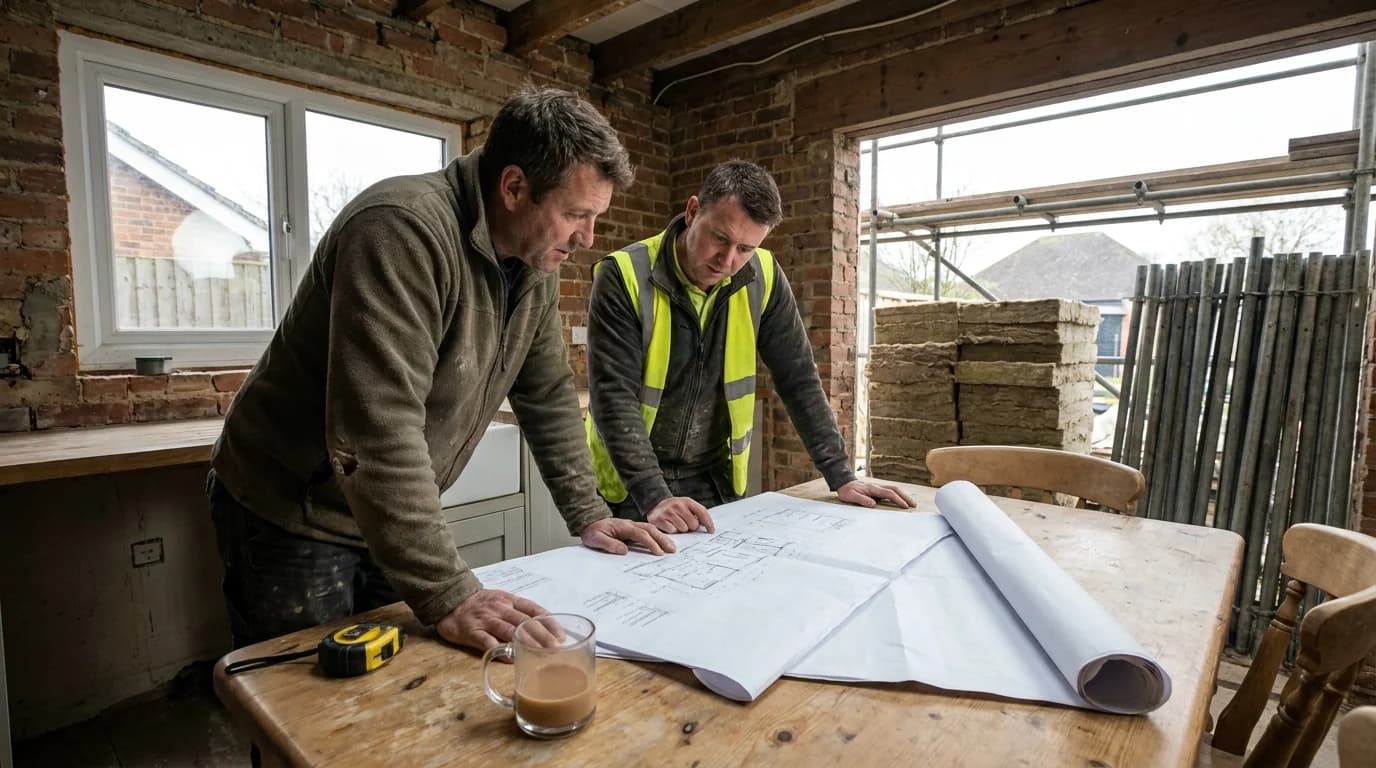
15 questions to ask before hiring a builder
The right questions reveal whether a builder is organised, honest and a good fit for your project. Here are fifteen to ask before you sign on the dotted line.
- Category
- Builder selection
- Author
- Star Hawk Builders Merchant
- Date
- 17 April 2025
- Read time
- 6 min
Builder selection · Star Hawk Builders Merchant
The right questions reveal whether a builder is organised, honest and a good fit for your project. Here are fifteen to ask before you sign on the dotted line.
6 min read · Published 17 April 2025
Hiring a builder is one of the biggest decisions you will make on any home project. The right builder delivers on time, on budget and with minimal stress. The wrong one can turn your home into a building site for months and leave you with poor workmanship and legal disputes.
Before you sign anything, ask the right questions. A professional builder will welcome them. A evasive or defensive builder is telling you something important. Here are fifteen questions to guide your conversation, plus what to look for in the answers.
1. Are you experienced with this type of project?
A builder who specialises in new builds may not be the best choice for a sensitive Victorian renovation. Ask how many similar projects they have completed in the last two years and whether you can see examples.
Trade bodies like the Federation of Master Builders and TrustMark can help you find builders who meet recognised standards.
2. Can I see references from recent clients?
Request at least two references for projects similar to yours. Then contact the homeowners and ask:
- Did the builder start and finish on time?
- Did the final price match the quote?
- How did they handle problems?
- Was the site left tidy?
- Would you use them again?
If possible, visit a completed project. Photographs in a portfolio are useful, but seeing work in person is better.
3. What insurance do you have?
Every builder should carry:
- Public liability insurance, usually £1 million or more.
- Employer's liability insurance if they have staff.
- Contractor's all-risk insurance for larger projects.
Ask for copies of certificates and check they are current. Do not just take their word for it.
4. Who will be on site day to day?
The person who quotes the job is not always the person managing the site. Ask who the site manager or foreman will be, how often they will visit and who you should contact with questions.
5. Do you use subcontractors?
Most builders use subcontractors for specialist trades such as electrics, plumbing, plastering and roofing. This is normal. What matters is whether those subcontractors are reliable, qualified and properly supervised.
Ask:
- Which trades will be subcontracted?
- Are they VAT registered and insured?
- How long have you worked with them?
6. What is included in the quote?
A detailed quote should include:
- A clear description of the work.
- Labour and materials separated where possible.
- Waste removal.
- VAT.
- Payment schedule.
- Start and estimated completion dates.
- Exclusions, such as kitchen units, tiling or decoration.
For help comparing quotes, read our guide on how to compare builder quotes line by line.
7. What is not included in the quote?
Exclusions matter as much as inclusions. Common exclusions include:
- Planning and building control fees.
- Structural engineer calculations.
- Scaffolding over a certain height.
- Making good the garden.
- Decoration and floor finishes.
Make sure you understand the full cost before committing.
8. What is the payment schedule?
Avoid builders who want a large deposit upfront. A reasonable schedule might look like this:
- 5–10% deposit on signing.
- Staged payments linked to completed milestones.
- A final retention of 5% held for a short period after completion.
For more detail, see our guide on when and how to pay your builder.
9. How long will the project take?
Ask for a realistic programme, not just a finish date. A good builder will break the project into stages and explain what could cause delays.
10. How do you handle changes to the scope?
Changes happen. Ask how extras are priced, how quickly you will be told about them and whether you need to approve them in writing before work proceeds.
11. What happens if you find unexpected problems?
Old houses hide surprises: rotten timber, defective wiring, asbestos, unstable walls. A good builder will stop work, explain the problem, give you options and agree a cost before carrying on.
12. What warranty do you offer?
Most reputable builders offer a workmanship warranty of six to twelve months for snagging and often longer for structural work. Some trade body memberships include additional guarantees. The NHBC provides warranties for new builds.
13. Will you provide a written contract?
A verbal agreement is not enough. Insist on a written contract that covers scope, price, payment schedule, start and completion dates, changes procedure, warranty and dispute resolution. For major projects, consider a JCT homeowner contract.
14. How do you manage health and safety on site?
A professional builder will have risk assessments, method statements and proper site signage. They will keep the site tidy, secure tools and materials and protect your family from hazards.
15. Why should I choose you?
This open question tells you a lot. A good builder will talk about their process, communication, attention to detail and pride in their work. A poor one may simply undercut the competition or pressure you to sign quickly.
How to check the company behind the builder
If the builder trades through a limited company, check the details on Companies House. Look at:
- How long the company has been trading.
- Whether accounts are filed on time.
- Any previous company names or dissolved businesses.
- Whether the registered address matches their trading address.
This is not a guarantee of quality, but it helps you avoid fly-by-night operators who close one company and open another.
Warning signs to walk away
- No fixed business address or only a mobile number.
- Refusal to provide references or insurance details.
- Pressure to sign today or pay a large cash deposit.
- Quotes given without visiting the site.
- Vague answers about materials, subcontractors or the programme.
- No willingness to put anything in writing.
If you suspect a rogue trader, report them to Action Fraud or your local Trading Standards team.
How to record the answers
Create a simple scorecard. For each builder, note their answers and your gut feeling. Include:
- Experience with similar projects.
- Quality of references.
- Insurance verified?
- Quote detail and clarity.
- Payment schedule fairness.
- Communication and professionalism.
This makes comparison easier and prevents you from relying on memory.
What to do after the questions
Once you have chosen a builder, do not relax entirely. Keep communication open, inspect work at key stages and hold back a final retention until snagging is complete. A good builder will not mind an engaged homeowner who asks sensible questions.
If you are still at the selection stage, read our guide on how to find the right builder for a complete vetting process.
Final thoughts
Asking questions is not rude. It is sensible. The builder you hire will be in your home for weeks or months, making decisions that affect your finances and daily life. The fifteen minutes you spend asking these questions can save you months of regret.
If you are comparing builders and need material prices to check their allowances, request a quote from Star Hawk Builders Merchant. You can also find your nearest branch or browse our case studies to see the kind of projects we supply.
Frequently asked questions
What should I ask a builder before hiring them?
Ask about experience, insurance, references, payment terms, subcontractors, warranties and how they handle changes and unexpected problems.
Should a builder provide references?
Yes. A reputable builder should provide at least two recent references for similar projects. Follow them up and visit the finished work if possible.
How much deposit should I pay a builder?
A small deposit of 5–10% is reasonable for materials. Avoid builders who demand large upfront payments. Staged payments linked to milestones are safer.
Does a builder need insurance?
Yes. They should have public liability insurance, employer's liability insurance if they have staff and contractor's all-risk cover for larger projects.
Need materials for your project?
Send us your material schedule and we'll come back with stock availability, a written quote and a delivery slot, usually within the hour during trade hours.
Related articles
More guides and advice to help your building project run smoothly.
How to find the right builder for your project
Finding the right builder is the difference between a smooth project and a nightmare. Here is a practical vetting process that protects your money, your home and your sanity.
How to compare builder quotes line by line
Comparing builder quotes is not about finding the lowest number. It is about making sure every builder is pricing the same scope, specification and terms.
How to avoid cowboy builders: a homeowner checklist
Cowboy builders cost UK homeowners millions every year. Learn the warning signs, the essential checks and the paperwork that protects you before any work begins.
When and how to pay your builder
Paying your builder the right way protects your money and keeps the project moving. Here is how to structure deposits, staged payments and final balances.