
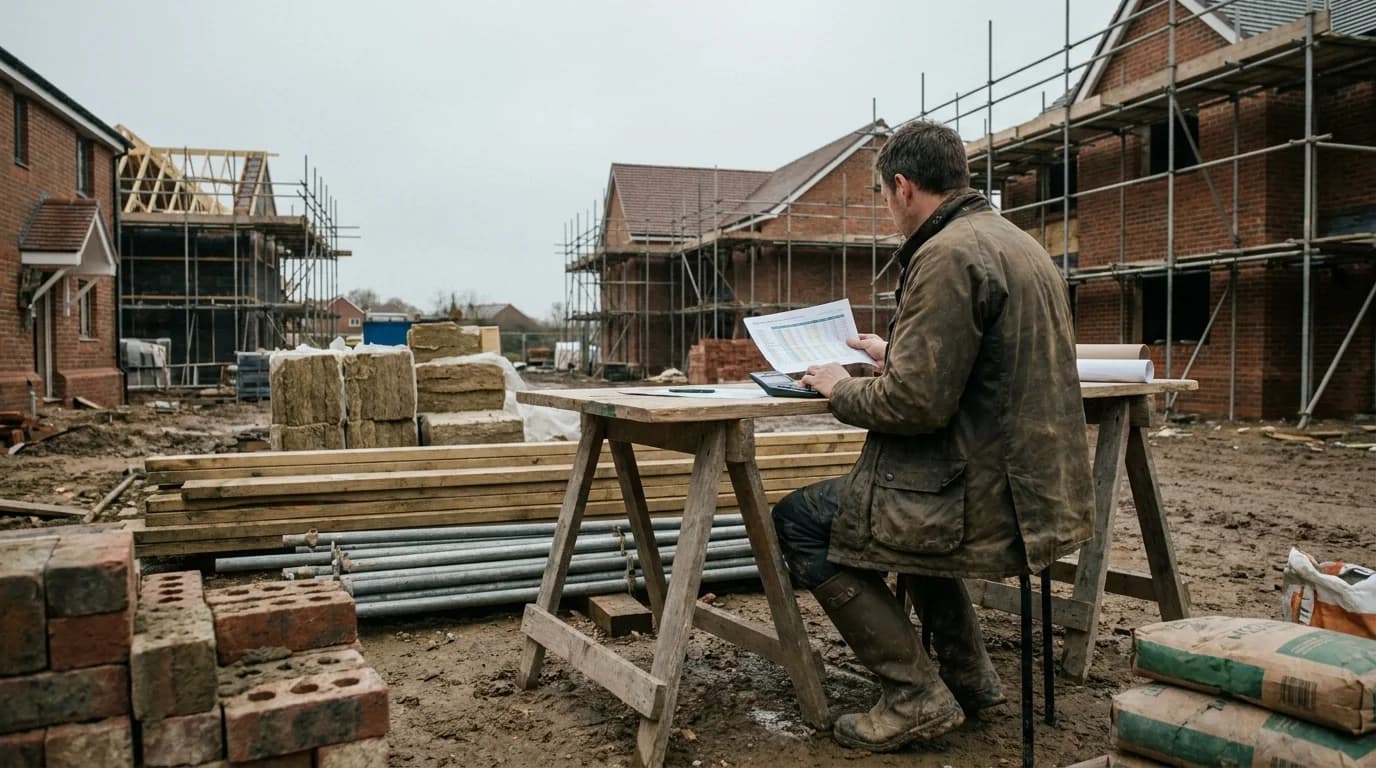
How much contingency do you need for a build?
A contingency is not optional padding. It is the part of your budget that stops unexpected problems from derailing your project.
- Category
- Budgeting
- Author
- Star Hawk Builders Merchant
- Date
- 15 January 2026
- Read time
- 6 min
Budgeting · Star Hawk Builders Merchant
A contingency is not optional padding. It is the part of your budget that stops unexpected problems from derailing your project.
6 min read · Published 15 January 2026
Every experienced builder has seen it: a project that looked straightforward on paper runs into unexpected costs halfway through. The ground is worse than expected. A wall turns out to be load-bearing. Asbestos appears behind the ceiling. Suddenly the budget is under pressure and the homeowner is faced with hard choices.
A contingency fund is the answer. It is not a luxury or a sign of pessimism. It is a realistic acknowledgement that building involves uncertainty. This guide explains how much contingency you need, what it should cover and how to manage it.
If you are budgeting for a project, request a materials quote from Star Hawk Builders Merchant or find your nearest branch to get firm prices before you start.
What is a contingency fund?
A contingency fund is a reserve of money set aside for costs that were not included in the original quote because they could not be foreseen. It covers things like:
- Unexpected ground conditions or foundation problems.
- Hidden defects such as rot, damp or structural movement.
- Discovery of asbestos or other hazardous materials.
- Necessary changes to comply with building regulations.
- Weather delays that increase labour or hire costs.
- Minor design changes forced by site conditions.
It should not be used for upgrades, nicer finishes or changes of mind. Those are variations, and they should be budgeted separately.
The standard contingency rule
Most builders and quantity surveyors recommend a contingency of 10–15% of the total build cost for straightforward projects on modern properties. For older properties, complex sites or projects involving structural alterations, increase this to 15–20%.
The reason older properties need more is simple: you cannot see everything until you open up the walls. A 1930s semi may have outdated electrics, no damp-proof course, crumbling mortar or unsupported chimney breasts. Each issue is fixable, but each costs money. For advice on your rights if things go wrong, Citizens Advice publishes helpful consumer guidance.
For very high-risk projects, such as basement excavations, listed building renovations or properties with known defects, a contingency of 20–25% may be sensible. Your architect, builder or surveyor can help you judge the right level.
Contingency examples for typical projects
| Project type | Build cost | 10% contingency | 15% contingency | 20% contingency |
| Single-storey rear extension | £50,000 | £5,000 | £7,500 | £10,000 |
| Two-storey extension | £90,000 | £9,000 | £13,500 | £18,000 |
| Full house renovation | £150,000 | £15,000 | £22,500 | £30,000 |
| Loft conversion | £55,000 | £5,500 | £8,250 | £11,000 |
| Garage conversion | £20,000 | £2,000 | £3,000 | £4,000 |
These figures are on top of the builder's quote. They should also be separate from professional fees, finishes and VAT.
Where do unexpected costs come from?
Understanding the common sources of unexpected cost helps you decide how much contingency is reasonable.
Ground conditions
Until you dig, you do not know what is underneath. Clay soil, high water tables, tree roots, unmapped drains and buried rubble can all increase foundation costs. Deepening foundations or switching to a different foundation type can add thousands.
Existing defects
Older properties often hide problems behind plaster and floorboards. Common discoveries include rotten timber, defective pointing, failed damp-proofing, unsafe wiring and leaking plumbing. These must be fixed before new work can progress.
Structural surprises
What looks like a simple stud partition may turn out to be a load-bearing wall. Removing it then requires a steel beam, structural engineer calculations and building control approval. That adds cost and time.
Asbestos
Properties built or refurbished before 2000 may contain asbestos in boards, insulation, roofing, tiles or textured coatings. Removal must be done by licensed contractors and can be expensive. An asbestos survey before work starts is money well spent.
Building control requirements
Building control may require additional insulation, ventilation, fire protection or structural measures that were not obvious from the original drawings. These changes are usually non-negotiable. You can read more about requirements on GOV.UK building regulations approval.
Access problems
If scaffolding cannot be erected as planned, materials have to be carried through the house or deliveries are blocked, labour costs rise. Tight urban sites and conservation areas are especially prone to access issues.
For more on these hidden costs, read our guide to hidden costs that blow your extension budget.
How to manage your contingency
Setting a contingency is only the first step. Managing it well is what keeps your project on track.
Keep it separate
Do not roll the contingency into the builder's quote. Keep it in a separate savings pot or savings account. This makes it harder to spend accidentally and easier to track.
Agree a process
Before work starts, agree with your builder how contingency spending will work. Ideally, any spend above the agreed quote should be approved in writing, with a clear description of the problem, the solution and the cost.
Record everything
Keep a running log of any extra costs, who authorised them and why they were necessary. This helps you understand where the money went and protects you if disputes arise later.
Do not use it for upgrades
It is tempting to use contingency money for that slightly nicer kitchen or bigger bifold doors. Resist. Upgrades should come from a separate finishes budget. Using contingency for extras leaves you exposed if a real problem appears later.
Review at key stages
Check your contingency balance at key project milestones: after demolition, after foundations, after structural work and at first fix. If you have used very little so far, you may be able to release some for finishes. If you have used a lot, you know to tighten control.
Contingency and payment schedules
Your payment schedule should be tied to completed stages, not calendar dates. This gives you leverage if problems arise and helps protect your contingency. Our guide to when and how to pay your builder explains how to structure fair payments.
Avoid paying large deposits upfront. If a builder fails or disputes arise, recovering money is difficult. A modest deposit with stage payments is the standard approach.
What if you do not have enough contingency?
If your contingency is too small, you have a few options:
- Pause the project until you can raise more funds.
- Reduce scope by postponing non-essential work.
- Choose cheaper finishes to free up cash.
- Remortgage or take a further advance if your lender agrees.
- Borrow from family or use a personal loan for smaller shortfalls.
None of these are ideal, which is why it is better to set a realistic contingency at the start.
Example: how contingency protects a project
Imagine you have a £60,000 quote for a single-storey extension. You set aside a 15% contingency of £9,000. During groundwork, the builder discovers an unmapped drain that must be rerouted. The extra work costs £3,500. Later, building control requires additional insulation, adding £1,800.
Without contingency, those costs would force you to borrow, cut finishes or argue with the builder. With contingency, the project continues. You still have £3,700 left for any further surprises.
Final thoughts
A contingency fund is one of the most important parts of a building budget. It is not a sign that things will go wrong. It is a sign that you have planned properly.
Set 10–15% for straightforward projects, 15–20% for older or complex work, and keep the money separate. Manage it carefully, do not spend it on upgrades and review the balance at key stages.
For help locking in material costs and building a realistic budget, request a quote from Star Hawk Builders Merchant, visit your nearest branch or explore our case studies for real project examples.
Frequently asked questions
What percentage should I keep as a building contingency?
Allow 10–15% for straightforward work on modern properties, and 15–20% for older buildings, complex sites or structural alterations.
Is a contingency the same as a builder's estimate allowance?
No. A contingency is your reserve for unknowns. An estimate allowance covers items the builder knows about but cannot price precisely.
When should I spend my contingency?
Only on genuine unforeseen issues such as hidden defects, ground conditions or necessary specification changes. Do not use it for upgrades.
What if I do not use my contingency?
That is the ideal outcome. Any unspent contingency becomes a buffer for finishes, furnishings or future maintenance.
Need materials for your project?
Send us your material schedule and we'll come back with stock availability, a written quote and a delivery slot, usually within the hour during trade hours.
Related articles
More guides and advice to help your building project run smoothly.
Hidden costs that blow your extension budget
The builder's quote is only part of the cost. Planning fees, building regulations, skips, scaffolding and contingencies can add thousands. Here is what to budget for.
How much does a home extension really cost?
Build costs are only part of the story. This guide breaks down realistic extension prices, hidden fees and how to budget for a project that does not run out of money.
When and how to pay your builder
Paying your builder the right way protects your money and keeps the project moving. Here is how to structure deposits, staged payments and final balances.
Why material prices matter before your first build
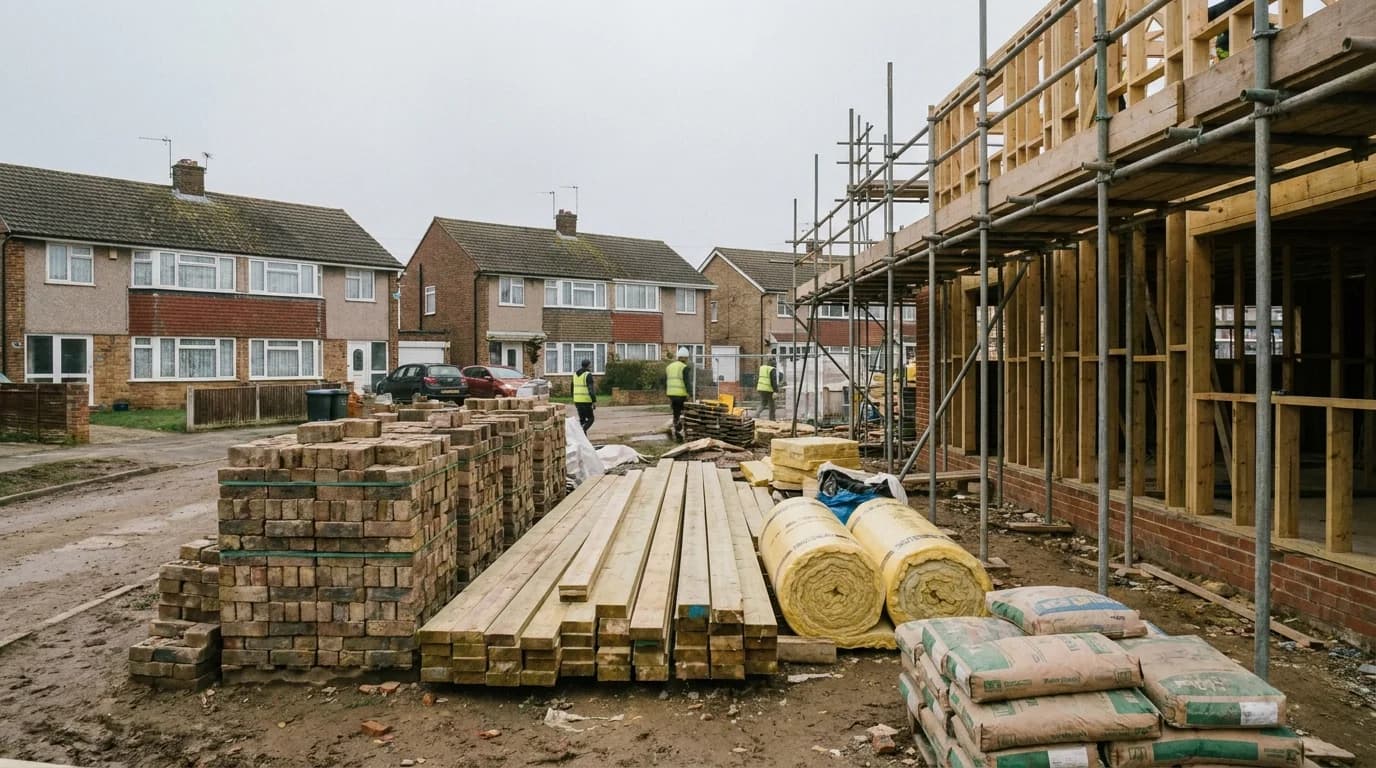
If you do not know what bricks, blocks, cement and timber actually cost, you cannot judge whether a quote is fair. Here is how to research material prices before your first build.
How to compare builder quotes line by line
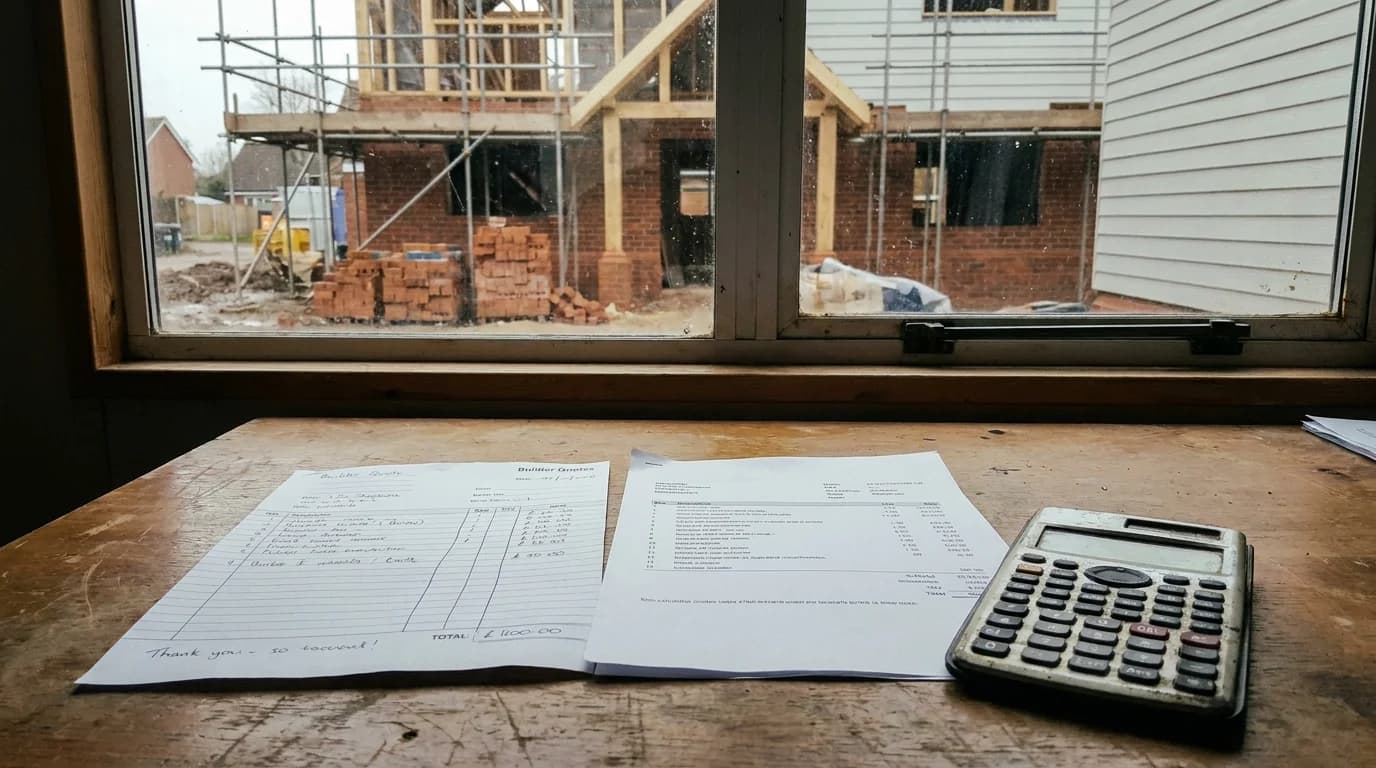
Comparing builder quotes is not about finding the lowest number. It is about making sure every builder is pricing the same scope, specification and terms.