
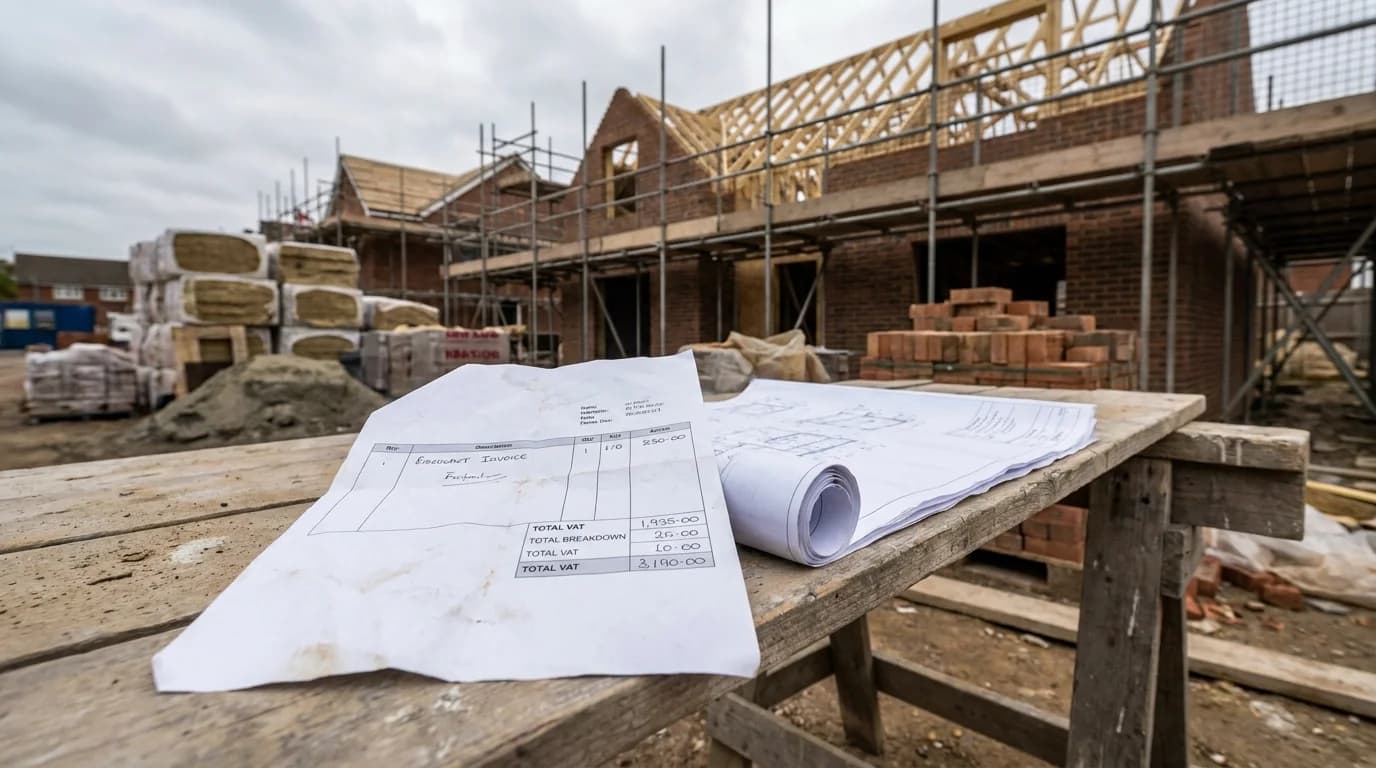
How to avoid VAT surprises on a building project
VAT can add thousands to a building project. Understanding when reduced rates apply and what is exempt helps you avoid budget shocks.
- Category
- Budgeting
- Author
- Star Hawk Builders Merchant
- Date
- 18 June 2026
- Read time
- 6 min
Budgeting · Star Hawk Builders Merchant
VAT can add thousands to a building project. Understanding when reduced rates apply and what is exempt helps you avoid budget shocks.
6 min read · Published 18 June 2026
VAT is one of the easiest costs to overlook when budgeting for a building project. A quote that looks manageable can suddenly feel much bigger once 20% is added. Worse, some homeowners assume certain types of work are VAT-free and only discover the truth when the invoice arrives.
This guide explains how VAT applies to domestic building work in the UK, when reduced or zero rates apply and how to make sure your budget is accurate. For official guidance, see GOV.UK VAT on domestic building work and GOV.UK VAT rates.
The standard rate: 20%
Most building work on existing homes is charged at the standard VAT rate of 20%. This includes:
- Extensions.
- Loft conversions.
- Garage conversions.
- Renovations and alterations.
- Repairs and maintenance.
- New kitchens and bathrooms.
- Roofing and replastering.
- Electrical and plumbing work.
If your builder is VAT registered, they must charge 20% on labour and materials for this type of work. A £50,000 quote becomes £60,000 once VAT is added.
When does reduced-rate VAT apply?
The reduced rate of 5% applies in a limited set of circumstances. The most common for homeowners are:
- Energy-saving materials. Some insulation, solar panels, heat pumps and controls may qualify for 5% VAT when installed in residential accommodation.
- Qualifying conversions. Converting a non-residential building into a dwelling, or converting a dwelling into a different number of dwellings, may qualify for reduced or zero rates on some elements.
- Renovations of empty dwellings. Work on properties that have been empty for two years or more may qualify for a reduced rate.
- Disabled adaptations. Certain work to adapt a home for a disabled person's needs may qualify for zero or reduced rating.
The rules are detailed and depend on the exact circumstances. If you think your project might qualify, ask your builder or accountant to confirm before work starts.
New builds and zero rating
The construction of a new dwelling is generally zero rated for VAT. This means the builder charges VAT at 0%, which is different from being VAT exempt. Zero rating allows the builder to recover VAT they have paid on materials and pass the benefit to you.
To qualify, the property must be a genuine new build used as a dwelling. Converting a non-residential building into a new dwelling may also qualify for zero or reduced rating on some elements.
Self-builders can sometimes reclaim VAT on materials for a new dwelling using the DIY housebuilders scheme. This is separate from the builder's VAT treatment.
What must be shown on a VAT invoice?
A proper VAT invoice from a builder should show:
- The builder's name, address and VAT registration number.
- The date of the invoice and a unique invoice number.
- A description of the work or materials supplied.
- The net amount before VAT.
- The VAT rate applied.
- The total VAT charged.
- The gross amount due.
If an invoice does not show these details, ask for a proper VAT invoice. You will need it for your records and any reclaims.
Is my builder VAT registered?
A builder must register for VAT if their turnover exceeds the VAT threshold, currently £85,000. Below that, registration is voluntary. Some smaller builders are not VAT registered and therefore cannot charge VAT.
A non-VAT-registered builder may appear cheaper, but that is not always the case. They cannot reclaim VAT on their own purchases, so their material costs may be higher. Always compare net prices and the overall package, not just the VAT figure.
VAT when multiple trades are involved
Larger projects often involve several tradespeople, each with their own VAT status. Your builder may be VAT registered, but the electrician, plumber or kitchen fitter might not be. Alternatively, one subcontractor may charge VAT while another does not.
Make sure you know the VAT status of everyone invoicing you. Keep separate records for each trade. This makes it easier to reconcile costs and check that you are paying the correct rate on each invoice.
Common VAT surprises
Quoted prices excluding VAT
Some builders quote excluding VAT, especially for larger projects. A £40,000 quote excluding VAT becomes £48,000 including VAT. Always confirm whether a quote is net or gross.
Mixed rates on the same project
A single project may include work at different VAT rates. For example, an extension might be standard rated, while energy-saving insulation within it qualifies for the reduced rate. The invoice should split these clearly.
Materials bought directly
If you buy materials yourself, you pay VAT at the point of purchase. In some cases, you may be able to reclaim VAT, but most homeowners cannot reclaim VAT on materials for standard domestic work.
Professional services
Architects, structural engineers and surveyors usually charge VAT at 20%. Their fees are separate from the builder's invoice, so make sure you include VAT on all professional costs.
Disbursements
Sometimes a builder pays a fee on your behalf, such as a building control fee, and recharges it. If it is treated as a disbursement, it may not be subject to VAT. If it is treated as part of the builder's supply, VAT will apply. Ask your builder how these items are handled.
How to budget for VAT
The safest approach is to assume standard-rate VAT on the total project cost unless you have written confirmation that a reduced or zero rate applies. Build your budget like this:
- Builder's quote excluding VAT.
- Professional fees excluding VAT.
- Statutory fees and surveys excluding VAT where applicable.
- Finishes and fittings excluding VAT.
- VAT at 20% on the total.
- Contingency on top.
This avoids nasty surprises and gives you a true picture of the cost.
Keeping VAT records
Keep every VAT invoice and receipt for your project. You may need them for your accountant, for a future HMRC enquiry, or to support a warranty or insurance claim. A proper VAT invoice should show the builder's VAT number, the net amount, the VAT rate and the gross total.
If a builder offers a discount for cash without a VAT invoice, be cautious. This may be a sign of undeclared income and could leave you without proof of payment or warranty protection.
VAT and payment schedules
Payment schedules should be clear about when VAT is due. Most builders invoice VAT as each stage is completed. Make sure you understand whether deposits, stage payments and final payments include VAT.
Our guide to when and how to pay your builder explains how to structure fair payments.
What if something looks wrong?
If a builder charges VAT but you suspect they are not registered, or if the VAT rate looks wrong for the type of work, ask for their VAT registration number and check it on the GOV.UK VAT registration checker.
Incorrect VAT treatment can cause problems for you and the builder. If in doubt, take professional advice from an accountant or tax adviser.
Final thoughts
VAT is a significant cost on most domestic building projects, but it should never be a surprise. Ask whether quotes include VAT, understand when reduced rates apply and budget for the full amount from the start.
For help building an accurate materials budget, request a quote from Star Hawk Builders Merchant, find your nearest branch or browse our case studies to see the kind of projects we support.
Frequently asked questions
How much VAT do I pay on building work?
Most building work is charged at the standard 20% VAT rate. Some work on new dwellings and qualifying conversions may qualify for a reduced or zero rate.
Can a builder charge reduced-rate VAT on an extension?
Extensions to existing homes are usually standard rated. Reduced rates may apply to certain energy-saving materials or disabled adaptations.
Is labour VAT exempt?
No. Labour for most domestic building work is standard rated unless it qualifies for a reduced or zero rate.
Should VAT be included in a builder's quote?
A professional quote should clearly state whether prices include or exclude VAT. Always ask if it is not clear.
Need materials for your project?
Send us your material schedule and we'll come back with stock availability, a written quote and a delivery slot, usually within the hour during trade hours.
Related articles
More guides and advice to help your building project run smoothly.
Hidden costs that blow your extension budget
The builder's quote is only part of the cost. Planning fees, building regulations, skips, scaffolding and contingencies can add thousands. Here is what to budget for.
How much does a home extension really cost?
Build costs are only part of the story. This guide breaks down realistic extension prices, hidden fees and how to budget for a project that does not run out of money.
How to compare builder quotes line by line
Comparing builder quotes is not about finding the lowest number. It is about making sure every builder is pricing the same scope, specification and terms.
How much contingency do you need for a build?
A contingency is not optional padding. It is the part of your budget that stops unexpected problems from derailing your project.
When and how to pay your builder
Paying your builder the right way protects your money and keeps the project moving. Here is how to structure deposits, staged payments and final balances.